Ruins & Rogues post-mortem
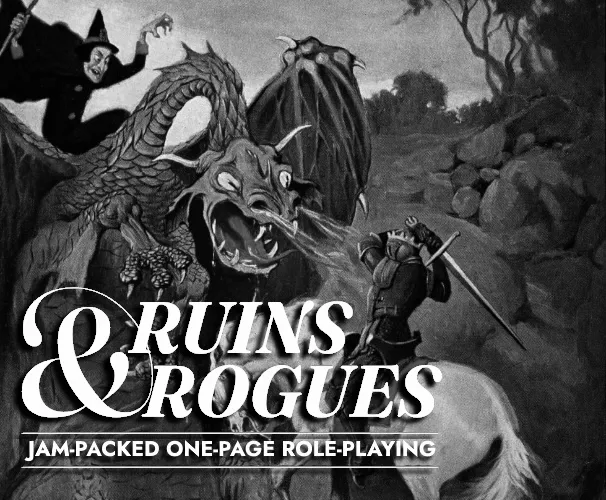
Here’s the pitch atop the Itch page for Ruins & Rogues, the fantasy heartbreaker that took me five years to make:
Ruins & Rogues packs everything you need to run a fantasy RPG onto a single sheet of paper. For one-shots, it offers lightning-fast character creation (even faster than Into the Odd!). For campaigns, it offers a simple system for leveling up over 4 to 6 sessions. All you need to play are pencils, paper, and four six-sided dice.
Today, nearly a year after I released the final version of the game, I want to investigate a simple question:
What is Ruins & Rogues for?
Here are d6 possible answers.
1. R&R is an easy and accessible way to play a game like D&D.
Certainly I wanted this to be true. But as my wise friend Max pointed out recently, “I don't know how many people are actually looking for ‘Weird problem solving with a procedurally generated freak’ when they say they want to check out D&D.”
2. R&R is an easy and accessible way to play OSR-style D&D.
R&R’s is completely incompatible with TSR D&D and Cairn, the twin lingua francas of the OSR. It’s not easy or accessible if you have to translate any published OSR adventure you want to run to a completely new design language.
3. R&R is for one-shots.
I’ll admit that cutting out rolling for stats and skipping straight to rolling for a starting package is great for one-shots, but then why is the skeleton of the system built around advancement over several sessions?
4. R&R is for short campaigns.
I never once tested R&R’s advancement system or used R&R to run a campaign. 36 pre-named characters might be fun for a one-shot, but I think a campaign could use more choice and variety.
5. R&R is for those who can’t afford expensive rulebooks or fancy dice.
Then why do I charge $2 for the game? Cairn has way more content and it’s 100% free! Cairn does require fancy dice, but nearly anyone can google “roll a d20” these days.
6. R&R is for introducing new players to RPGs.
Do I even want dungeoncrawlers to be how I introduce people to the hobby? Even putting that question aside, none of the fiddly little rules a player has to learn to play R&R are transferable to other, more popular games. It’s a terrible introduction.
What did I learn?
Exactly one year ago today, I wrote “Not an adventure,” which marked the beginning of a new era of my blog.
The world is falling deeper and deeper into crisis. The horrors of World War I and World War II are back. We need damning, realistic art that exposes reality and rouses action now more than ever.
A week later, I released R&R. In October, I wrote “Four paths to a successful OSR game,” which is very much a product of my reflections in the wake of R&R’s release.
You can only recapitulate D&D nostalgia so many times; there are only so many genres to set a dungeoncrawler in; the rules can’t get much lighter. You can make infinite custom systems for bespoke adventures, though.
In November, I wrote “Finding my community.”
I think, whatever I do, I want to inspire people to express themselves artistically through conversation games. And I want to build a community that isn't centered around my own work in that field so much as it is about inspiring everyone to strive for more with what they make.
In December, I wrote Tim B.’s Rule of Three.
For a long time I’ve wanted to delve into deeper social, artistic, and political themes with my work. For a long time I’ve wanted to make games that I could wrangle anyone to play at a moment’s notice. And, as much as I still love problem-solvey dungeon games, I think social matrix games might be a better way to do those things.
And in February, I wrote, “For a new social realism in games.”
Building a community or an artistic movement around [social realism in games] is going to be a difficult process, I think. I don't think I can do it without developing better examples myself of what sort of game I think we can achieve.
In summary, I learned:
- You need to know what your game is for. First, what are you trying to achieve with your art? Second, how does your game grab players, help the GM prep, and help everyone play?
- You need to know what kind of community you want to build and what such a community needs to grow.
- Scenario-content is far more interesting and valuable than ruleset-form.
Addendum (May 10)
It occurs to me, reconsidering my d6 points above, that point 2 and part of point 6 would be addressed if I simply did the work to make R&R popular.
If I converted adventures to R&R and built a supportive community around the game, it would be easy and accessible. If R&R were popular, then learning it would be a useful entry to the OSR/NSR scene.
So. what are the barriers to doing that, if they exist? I could point to all the other problems I listed. I could say that Cairn is so popular in the rules-light folk D&D niche that it’s fruitless to try and compete, and maybe that’s partly true.
But ultimately, if I’m really being honest? The real barrier was that by the time I finished Ruins & Rogues, my heart just wasn’t in the game anymore.
The spark for R&R was playing silly little one-shot dungeon games with my fiancé, J. I wanted a game that was perfect for those moments where I just wanted to run a little spur-of-the-moment dungeon for J or some friends or strangers.
But by the time R&R was finished… silly little one-shot dungeons weren’t fun anymore. We saw everything the best of them had to offer. The world crisis grew. Our relationship grew. My tastes and J’s tastes grew richer and more complicated. We had moved on.
I think, here at the end of an addendum to this post, I still haven’t told the real story of Ruins & Rogues. I haven’t explained how the game came about during the years I spent in therapy discovering my relationship to my own peculiar flavor of OCD.
I haven’t told you how I spent a week in the psych ward once because I was so obsessed with working on some version of this game that it was starting to scare me. They put me on a new pill, but I still managed to sneak into the psych ward’s TV room when no one else was there and watch an interview with Chris McDowall on YouTube.
I have mellowed out a lot since then. I’ve grown up a lot. But it’s still very easy for me to slip into rules-tinkering as a means of escape from all the stress in my life. It’s very easy to put blinders on, tune out the world, and hyperfixate on a tweaking a specific rule with no guiding star except what tickles my brain in the right spot.
In the end, I think I’m proudest of the starting item list in Ruins & Rogues because it was the first part of the game that wasn’t just mindless rules-tinkering. It was really hard work to come up with 108 starting items that feel inspiring and useful and distinct. There’s a reason it was the last thing I added to the game.
Two of you who read this post have told me that, in spite of everything, you do like Ruinous, my ashcan sequel to R&R. I sometimes forget it exists! But maybe I’ll have to salvage it and put it into layout one of these days.
Here’s to a future of making with intent.