For a new social realism in games
I.
Four years and five days ago, on Feb. 23, 2022, Yochai Gal asked me if I’d like to be a moderator on his NSR Discord server. After some hesitation, I agreed. The next day, Russia invaded Ukraine. Over the next four years, I deepened my involvement with the NSR server as the world plunged deeper into crisis.
This past month, Discord's upcoming ID requirements sparked renewed interest in Discord alternatives. I said I might set up a Zulip instance, but I hesitated. Did I want to recreate the NSR server, or was this an opportunity to create a new community? Early this morning, the US and Israel attacked Iran.
In May, I wrote, "The horrors of World War I and World War II are back. We need damning, realistic art that exposes reality and rouses action now more than ever." That has only become more true. But just above that, I wrote:
World War I was not an adventure. Remarque responded by writing about what the war was; Tolkien responded by writing about what the war wasn't. Fantasy has been about what the modern world is not ever since.
It's healthy, I think, to wish the world was different. It's healthy to play games with your friends. It's okay to pretend the world is simpler than it is for a little while. It's okay to have fun.
But as an artist, I can't help but think to myself: do I want to be more like Tolkien or more like Remarque? And I don't have a clear answer.
In January, I released my scenario game Lull Astir, a socially realistic (Remarque-ian?) take on the late medieval period typically treated as fantasy (Tolkienian). In November, after describing Lull Astir, I wrote:
I don't know yet if I want to build a new community around "Dramatic Matrix Games" or whatever you want to call this. I don't know if I want to create a new movement with a new three-letter-initialism.
But I think, whatever I do, I want to inspire people to express themselves artistically through conversation games. And I want to build a community that isn't centered around my own work in that field so much as it is about inspiring everyone to strive for more with what they make.
II.
Currently, there is a bundle running on Itch.io titled No ICE in Minnesota. For a $10 donation to the Immigrant Law Center of Minnesota, one can download 1,439 digital products, including video games as well as tabletop games.
Taking a look at the tabletop games included, a few take the "-punk" approach to political commentary, imagining a world in which a handful of extraordinary individuals battle the powers that be (FIST, ECO MOFOS!!). A few are more blunt about it (Punch A F****** Nazi).
But most games in the bundle make little if any comment on the political crisis. And I can't help but notice that the response to the ICE assault on Minneapolis among game designers takes the form of a bundle of existing games and not a game jam encouraging new work. Where is our artistic response to this situation, not just in how we sell our games but in the games themselves?
Some will point out that this is a problem across the arts, and not just in games, and that's true. I focus on games because I'm a game designer. Others will argue that the role of tabletop games is not to comment on politics but to contrast them or provide a distraction from them. Certainly that's the role they play for some, and for me too at times. Everyone needs a break now and then.
But as I said in the quote above, I think there is room to strive for more. I'm writing this post to gauge interest and see how many people agree with me.
III.
This post is titled "For a new social realism in games." Earlier, I described Lull Astir as a "socially realistic" game. What do I mean by social realism?
The Wikipedia article is a start: "Social realism is work... that aims to draw attention to the real socio-political conditions of the working class as a means to critique the power structures behind these conditions." The article continues:
Social realism should not be confused with socialist realism, the official Soviet art form that was institutionalized by Joseph Stalin in 1934 and was later adopted by allied Communist parties worldwide. It is also different from realism as it not only presents conditions of the poor, but does so by conveying the tensions between two opposing forces, such as between farmers and their feudal lord. [Emphasis mine]
This point I've emphasized, conveying the tensions between social forces (or, more precisely, social classes), is critical to my conception of social realism and essential to what I tried to do with Lull Astir for the late-medieval period.
Lull Astir is loosely based on the English peasants' revolt of 1381. Its characters embody the early strivings of the peasantry and nascent bourgeoisie for democracy in opposition to a decaying feudal order.
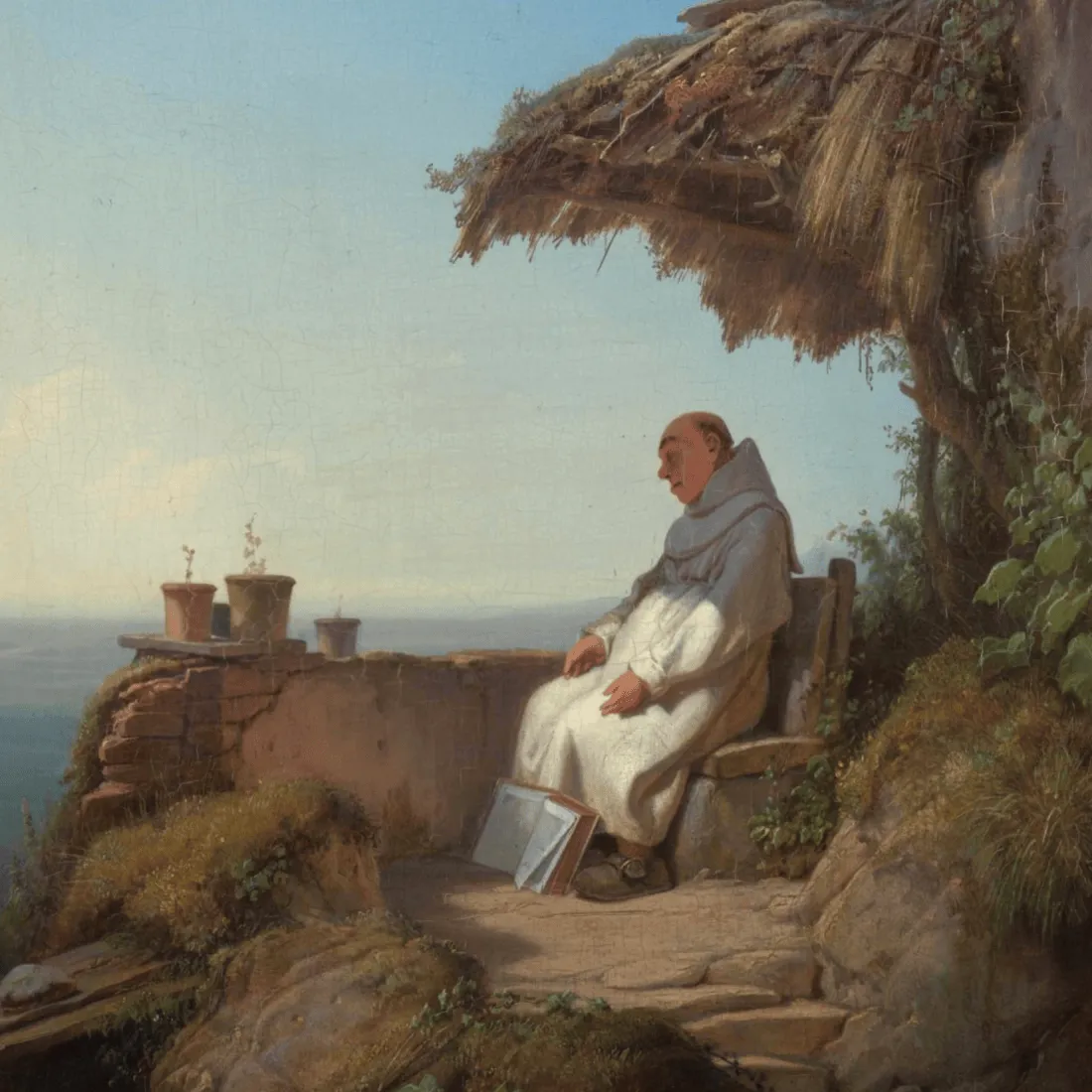
Central to the scenario is Abbot Eoin, a monk who wants nothing to do with politics, suddenly finding himself at the center of a major political crisis.
At first, I thought scenario games (also known as social matrix games) are uniquely suited to socially realistic tabletop games. Perhaps they are! Instead of the traditional role-playing game divide between players inhabiting a single character and a GM controlling the world, scenario games provide all players with equal authority to tell a story about multiple competing interests.
But I think there is plenty of room for exploration of socially realistic RPGs with the traditional divide. Last week, I was delighted to see Chris McDowall's stream of Gallows Corner, a historical RPG based on the same period as Lull Astir in which players play as ordinary people organizing the peasants' revolt. I am now watching the development of Gallows Corner with great interest.
IV.
You might have noticed, however, that neither Lull Astir nor Gallows Corner deals with the class conflict present in the modern world. This is what I am looking to address in future projects, and if you're a game designer, you can consider this post an invitation to do it alongside me.
Building a community or an artistic movement around an idea like this is going to be a difficult process, I think. I don't think I can do it without developing better examples myself of what sort of game I think we can achieve.
But I didn't want to sit around and wait until I finish something that meets the new standards I'm setting out for myself. I want to start a conversation about what I think is an urgent need for socially realistic games.
Politics, of course, is no substitute for art. In a previous blog post, I quoted my own pitch for the first Lull Astir players:
[Lull Astir is] the culmination of six or seven months of intense creative introspection via hundreds of pages of handwritten notes. It’s very personal to me in a way that nothing else I’ve run has ever been, but at the same time I hope it speaks to something universal about the times we’re living in.
In other words, I didn't simply set out to make a political game and make it. I had to develop a feel for it in my heart and in my bones.
Again, this is going to take time. If you're reading this and you agree with me and you want to make games like this, then I'm not expecting you to make this sort of game tomorrow. But I want you to start thinking and feeling about it.
V.
I have no idea what sort of response this post will get. For all I know it will fall on deaf ears, or I'll be ridiculed for thinking about games when I should be thinking about politics or vice-versa. Maybe no one will read it.
But if you did read it, thank you for making it this far. And I hope you'll tell me what you think in the thread I'm about to make for it in the #blog-posts channel of the NSR Cauldron Discord server — still my home on the internet, for now.